If you’ve ever stared at an invoice and wondered why no VAT is showing up, you’ve probably run into one of two things: the item is zero-rated, or it’s VAT exempt. On the surface, they look identical; the customer pays no VAT either way. But for the business selling the goods or services, these two categories work in completely different ways, and mixing them up can cost real money.
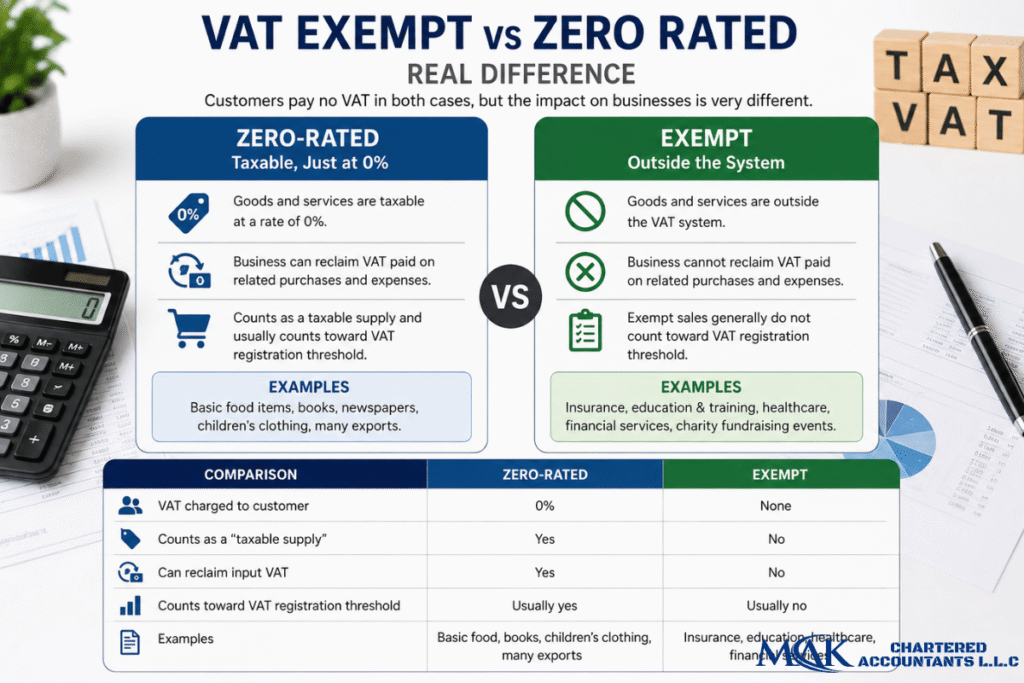
- Zero-rated means the item is taxable, just at a rate of 0%. Because it’s still officially “in the VAT system,” the business can reclaim the VAT it paid on related costs.
- Exempt means the item sits outside the VAT system entirely. No VAT is charged, but the business also cannot reclaim any VAT on the costs of producing or supplying it.
VAT exempt and zero-rated supplies may both result in customers paying no VAT, but they have different tax implications for businesses. Zero-rated supplies are taxable at 0%, allowing businesses to recover eligible input VAT, while exempt supplies are outside the VAT system and generally do not allow input VAT recovery. Understanding the distinction is essential for accurate VAT reporting, compliance with Federal Tax Authority (FTA) regulations, and avoiding costly errors.
Zero-Rated: Taxable, Just at 0%
Zero-rated goods and services are technically part of the VAT system. The rate charged happens to be nil, but because they’re classed as taxable supplies, a business can still claim back the VAT it paid on ingredients, materials, equipment, or overheads used to produce them.
Common examples include most basic food items, books and newspapers, children’s clothing, and many exports. Governments often zero-rate essentials specifically to keep costs down for everyday consumers, especially lower-income households.
For a business, zero-rating is the better position of the two. You’re not charging VAT, but you’re also not losing out , you keep the right to reclaim VAT on your costs, which helps cash flow.
Exempt: Outside the System Altogether
Exempt supplies don’t fall under VAT rules at all. That means:
- No VAT is charged to the customer.
- The business cannot reclaim VAT paid on related purchases or expenses.
- Exempt sales generally don’t count toward the VAT registration threshold.
Typical exempt categories include financial services, insurance, education and training, healthcare, and some charity fundraising events.
Because input VAT can’t be recovered, that cost doesn’t just disappear. It usually gets absorbed into the business’s overheads, which can quietly push up prices or eat into margins, especially for businesses with high supply costs.
Why the Difference Actually Matters
From a customer’s point of view, exempt and zero-rated purchases feel the same, no VAT added to the bill. But from the seller’s side, the financial impact is very different.
A business making zero-rated supplies is in a stronger position, it keeps full input VAT recovery. A business making exempt supplies effectively pays that VAT as an unrecoverable cost.
This is also where partial exemption comes in. Many businesses sell a mix of taxable (including zero-rated) and exempt supplies. In that case, only part of the input VAT can typically be reclaimed, calculated using a specific formula. Getting this apportionment right is one of the trickier parts of VAT compliance.
Getting It Wrong Is Expensive
Misclassifying a supply isn’t just a paperwork issue:
- Treating an exempt supply as zero-rated means over-claiming input VAT, money that will eventually need to be repaid, often with penalties and interest attached.
- Treating a zero-rated supply as exempt means under-claiming. The business simply leaves money on the table that it was entitled to reclaim.
Either way, the fix usually involves back-dated corrections, extra admin, and sometimes a call from the tax authority you’d rather avoid.
A Quick Comparison
| Zero-Rated | Exempt | |
| VAT charged to customer | 0% | None |
| Counts as a “taxable supply” | Yes | No |
| Can reclaim input VAT | Yes | No |
| Counts toward VAT registration threshold | Usually yes | Usually no |
| Examples | Basic food, books, children’s clothing, many exports | Insurance, education, healthcare, financial services |
Conclusion
Both zero-rated and exempt supplies mean the customer doesn’t pay VAT but that’s where the similarity ends. Zero-rated status keeps a business inside the VAT system and protects its right to reclaim input VAT. Exempt status removes that right entirely, turning input VAT into a permanent cost.
If you’re not sure how a product or service should be classified, it’s worth checking with your local tax authority’s guidance or a VAT specialist like MAK. The rules vary by country, and getting the classification right from the start saves a lot of hassle down the line.