Company Liquidation vs Strike-Off: Understand the Right Closure Route
Stopping business activities does not always mean a company is legally closed. In the UAE, some companies must complete formal liquidation. Other businesses may have a register-removal route, if their licensing authority permits it. The right choice depends on the company type, its debts, and the rules of the relevant authority.
This guide explains the difference in simple English and helps you identify what to check before applying.
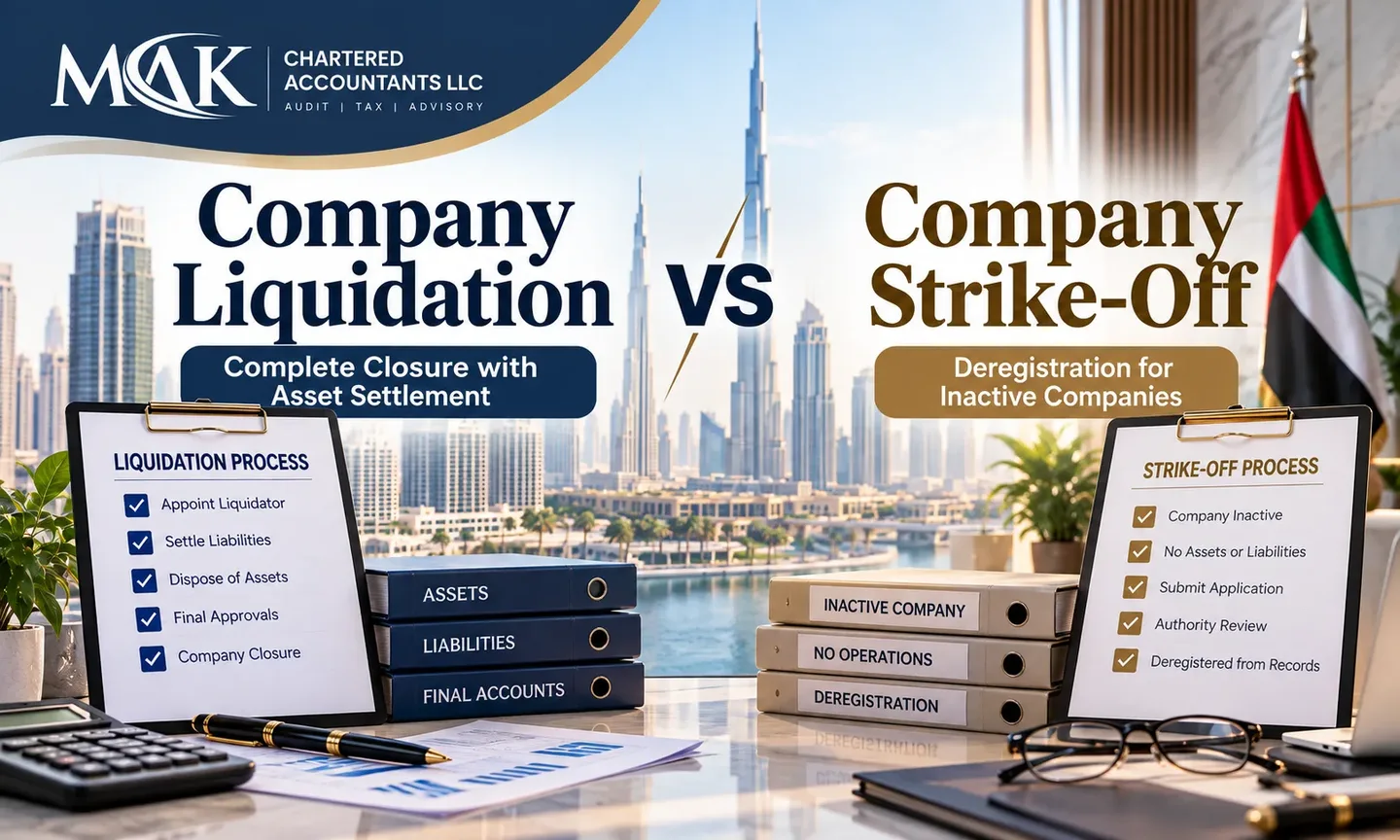
Illustration of formal winding-up records compared with company removal from a register.
What Is Company Liquidation in the UAE?
Company liquidation is a formal process used to close a company’s affairs. It can involve appointing a liquidator, reviewing its assets and debts, collecting money owed to the business, settling creditor claims, and preparing final reports.
For example, the usual Dubai commercial-company closure route requires a shareholder or general assembly decision, a liquidator appointment, publication of a notice, and final deregistration steps. The actual requirements depend on the business’s legal form and authority.
If you need professional help, see MAK’s company liquidation services in UAE. This commercial service page covers accounting, reporting and documentation support.
What Does Company Strike-Off Mean?
Strike-off usually means that a company is removed from the register by an available administrative procedure. The term does not describe one single procedure used by every UAE authority. Some jurisdictions offer routes for eligible inactive or dormant businesses, but others require formal liquidation or a specific termination process.
A company should not assume that strike-off is faster, cheaper, or available simply because it has stopped trading. The registrar may ask for clearances, documents or evidence that outstanding obligations have been addressed.
Company Liquidation vs Company Strike-Off in UAE: Key Differences
| What to compare | Company liquidation | Company strike-off |
|---|---|---|
| Main purpose | Wind up the business and settle its affairs | Remove an eligible company from a register where permitted |
| Liquidator | Required for many formal company types and routes | Depends on the authority’s rules and route |
| Assets and debts | Reviewed and dealt with through the formal process | Unresolved obligations may prevent or complicate removal |
| Documents | May include resolutions, reports, notices and clearances | May include declarations, approvals and clearances |
| Eligibility | Depends on legal form and applicable law | Only where an authority offers the route and conditions are met |
| Tax matters | Separate VAT and Corporate Tax obligations may remain | Separate VAT and Corporate Tax obligations may remain |
The better route is not the same for every business. An LLC with employees and open liabilities may face different requirements from an inactive entity under a separate free zone registrar.
When Formal Liquidation May Be Needed
- The company has a legal form that requires a liquidator.
- There are creditors, assets or unsettled liabilities to review.
- The relevant authority requires reports or public notices.
- Partners need a formal winding-up process.
When an Administrative Removal Route May Be Possible
- The relevant registry offers an administrative route.
- The company meets that route’s eligibility conditions.
- Required declarations and clearances are available.
- The authority accepts the application and supporting records.
Do not select a route until eligibility is confirmed in writing or through the official service guidance.
Mainland vs Free Zone: Why the Closure Route Can Change
Mainland companies in Dubai
Dubai’s official closure guidance explains different steps for sole proprietorships, civil companies, commercial companies and branches. For commercial companies, the standard procedure can include a liquidator appointment and a creditor notice. The published 45-day claim period is part of that particular procedure, not a guaranteed total completion time.
Free zone businesses
Free zone registrars have their own termination rules. DMCC, JAFZA and other authorities may require different resolutions, clearances, reports and filings. Some routes may use terms such as winding up, termination or deregistration instead of strike-off.
For authority-specific support, explore Free Zone Company Liquidation services and review the official UAE free zone closure guidance.
Five Checks to Make Before Closing a UAE Company
- Confirm the legal form: Find out whether the entity is an LLC, branch, sole proprietorship or free zone company.
- Identify the correct authority: Check the issuing authority and its current company termination rules.
- Review obligations: List creditors, unpaid invoices, employee dues, leases and contracts.
- Review tax status: Check VAT and Corporate Tax registrations, final returns and deregistration conditions.
- Prepare documents: Gather the licence, incorporation records, resolutions, financial accounts and required clearances.
Our company liquidation documents checklist explains the usual records to review.
Does Strike-Off Remove Debts and Tax Duties?
No business owner should assume that removal from a register automatically removes debts or other legal duties. Liability questions depend on the facts, legal structure and applicable law. Tax deregistration also follows separate rules and deadlines.
For practical closure documentation support, see MAK’s company license cancellation services. For tax filing requirements, use the Federal Tax Authority’s official guidance.
How MAK Can Help Before You Choose a Closure Route
MAK Chartered Accountants L.L.C. provides accounting, reporting and tax support for businesses in the UAE. Our team can review available financial information, explain documentation needs and help prepare records required within an agreed scope of work.
Financial Records
Review bank balances, receivables, supplier dues and other open items before closure.
Closure Documents
Organize company records, resolutions, clearances and supporting information.
Liquidator Support
Understand appointment documentation and related reporting requirements when applicable.
Tax Records
Review records that may be needed for VAT or Corporate Tax filings and deregistration.
MAK’s assistance does not replace a legal determination by the licensing authority or a professional authorized to act in that capacity.
Not Sure Whether Your UAE Company Needs Liquidation or Strike-Off?
Tell MAK your company type, licensing authority and current status. We can review the accounting and documentation work involved and help you identify the next questions for the relevant authority.
WhatsApp: +971 50 276 2132 | [email protected]
Official references: Dubai Government — Closing Your Business and UAE Government — Free Zone Business Closure.