
Closing a company in the UAE involves more than cancelling a trade licence or stopping business operations. The company must review its financial position, settle liabilities, address tax obligations and complete the requirements of the relevant licensing authority.
A liquidation audit report provides an independent review of the company’s financial position during this closing process. It helps establish what the company owns, what it owes and whether its financial records support the proposed closure. However, the requirement is not identical for every UAE business. It depends on the company’s legal structure, licensing authority and applicable closure procedure.
What Is a Liquidation Audit Report in the UAE?
A liquidation audit is a financial review performed specifically in connection with company liquidation or closure. Unlike a normal annual audit, it focuses on the company’s financial position at the end of its business life. The review may cover:
- Financial statements
- Assets and liabilities
- Bank balances
- Receivables and payables
- Loans
- Shareholder balances
- Employee obligations
- VAT and Corporate Tax matters
- Other outstanding financial obligations
Depending on the authority, the final document may be called a Liquidation Audit Report, Auditor’s Report, Liquidation Report, Auditor’s Certificate or Final Financial Statement Report. The terminology and format can differ between Mainland and Free Zone jurisdictions.
Is a Liquidation Audit Report Mandatory in the UAE?
There is no single rule stating that the same report is mandatory for every business in every UAE jurisdiction.
For Dubai Mainland LLCs, competitor guidance states that a Liquidation Report is required as part of the formal closure process. The UAE Government’s mainland guidance also requires company liquidation documents, including an auditor’s letter for applicable company forms, before final deregistration.
For Free Zone companies, the requirement depends on the individual authority. This can include jurisdictions such as DMCC, JAFZA, IFZA, Dubai Silicon Oasis (DSO), Dubai Development Authority (DDA), RAKEZ, DIFC and ADGM.
Therefore, businesses should confirm the exact requirement with the relevant licensing authority before beginning liquidation.
Why Is a Liquidation Audit Required?
The main purpose is to create a reliable financial picture before the company is closed. A liquidation audit can help identify:
- Unrecorded liabilities
- Unreconciled bank balances
- Outstanding receivables
- Supplier and loan balances
- Remaining company assets
- Shareholder or director balances
- Unpaid employee obligations
- VAT and Corporate Tax matters
It also supports a transparent settlement of creditors and shareholders. NUFCA explains that the audit can help verify assets and liabilities and support fair distribution of remaining assets after creditor obligations are addressed.
For authorities, the report provides supporting evidence that the company’s financial affairs have been reviewed before final licence cancellation or deregistration.
What Does a Liquidation Audit Cover?
A liquidation audit is more focused on closure than a normal financial statement audit.
| Financial Records | Assets | Liabilities |
| General ledger | Fixed assets | Supplier payables |
| Trial balance | Inventory | Bank loans |
| Financial statements | Cash | Employee dues |
| Accounting records | Receivables | Government obligations |
| Bank statements | Property or equipment | Tax liabilities |
| Bank reconciliations | Other company-owned assets | Contingent liabilities |
| Other outstanding claims |
Assets: The review can assess whether assets can realistically be recovered during liquidation. Rather than relying only on their historical book value. NUFCA highlights asset verification and liquidation-value assessment as important parts of the audit.
Liabilities: The objective is to identify outstanding liabilities that must be settled before the company is formally closed.
Liquidation Report UAE Cost : What Does It Include?
The liquidation report UAE cost depends on several factors, so there is no universal fee for every company. The final professional fee can depend on:
- Company size
- Legal structure
- Number of transactions
- Quality of accounting records
- Number of bank accounts
- Complexity of assets and liabilities
- Outstanding tax matters
- Licensing authority
- Whether additional financial statements are required
A simple company with complete records may require less audit work than a business with years of unreconciled transactions, outstanding loans or incomplete accounts. The cost should therefore be confirmed with the licensed auditor or liquidation specialist after reviewing the company’s records.
What Documents Are Required for a Liquidation Audit?
The auditor may request both corporate and financial documents.
Corporate Documents
- Trade licence
- Memorandum and Articles of Association
- Certificate of incorporation, where applicable
- Shareholder resolution
- Liquidator appointment documents
Accounting Documents
- Trial balance
- General ledger
- Financial statements
- Bank statements
- Bank reconciliations
- Receivables and payables schedules
Asset and Liability Records
- Fixed asset register
- Inventory records
- Loan statements
- Employee settlement records
- Supporting asset documents
- Liability schedules
Tax and Compliance Records
- VAT registration details
- VAT returns
- Corporate Tax registration
- Corporate Tax returns
- Tax correspondence
- VAT deregistration documents, where applicable
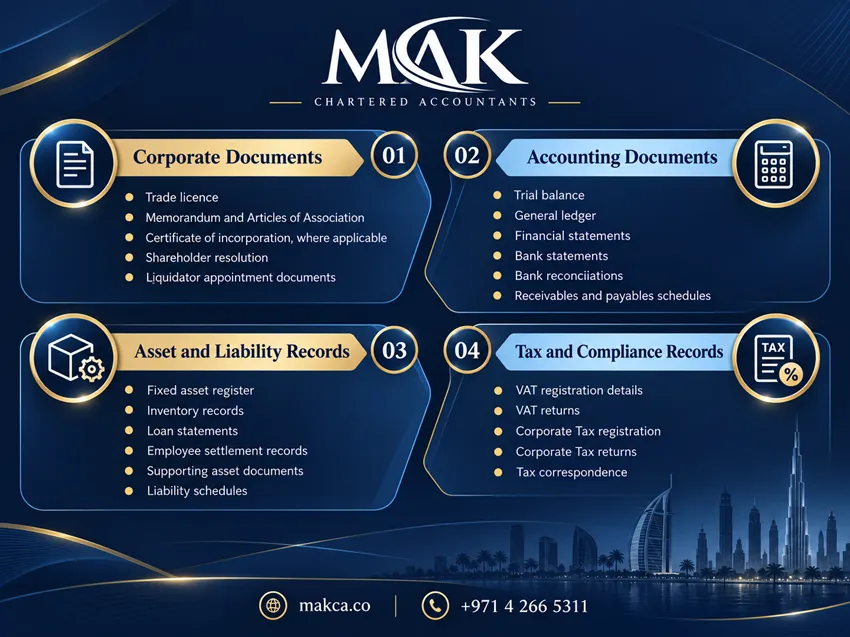
The exact document list depends on the company and relevant authority. ZILE’s guidance similarly identifies corporate records, accounting records, asset schedules, liability information, tax records, customs documents, lease records and clearance certificates as common supporting documents.
Liquidation Audit Process in the UAE
The process generally follows these stages:
- 1. Approve the Company Closure
- 2. Appoint the Liquidator
- 3. Update the Financial Records
- 4. Review Assets and Liabilities
- 5. Complete Tax and Government Requirements
- 6. Prepare the Liquidation Audit Report
- 7. Submit the Final Closure Documents
Liquidator vs Auditor: What Is the Difference?
The liquidator manages the liquidation itself. This can include collecting receivables, dealing with assets, settling liabilities, closing contracts and preparing the final liquidation account.
The auditor independently reviews financial information and supporting records and prepares the required audit or liquidation report.
The distinction is particularly important between both. It is because applicable UAE company law restricts the same person from acting as both liquidator and current/recent auditor in the circumstances specified by law.
What Happens If the Report Is Not Submitted?
Where a liquidation report or auditor’s certificate is required, failing to provide it can prevent completion of the company closure process. The consequences may include:
- Delay in licence cancellation
- Continued regulatory obligations
- Problems completing deregistration
- Outstanding tax compliance
- Employee or visa issues
- Additional administrative costs or penalties
Capital Closure specifically notes that, for the Mainland LLC scenario it describes. The report is submitted toward the final stage and is required before the final licence cancellation certificate is issued.
Liquidation Report UAE Cost: How Can Businesses Control It?
The easiest way to avoid unnecessary audit costs is to prepare the company’s records before the engagement begins. Businesses should:
- Reconcile all bank accounts
- Update the general ledger
- Clear old receivables and payables
- Prepare asset schedules
- Review shareholder balances
- Organise tax records
- Collect employee settlement documents
- Prepare the required corporate resolutions
- Keep all authority clearance certificates together
Complete records can reduce audit queries and make the final review more efficient. ZILE notes that the audit timeline and effort can vary according to company size, transaction volume, document availability and accounting-record quality.
Conclusion
A liquidation audit is an important financial control during company closure. But the exact Liquidation Report UAE Cost requirement depends on the company structure, jurisdiction and licensing authority. For a Dubai Mainland LLC, a liquidation report forms an important part of the formal closure process, while Free Zone requirements can differ.
The report helps establish a clear financial position, supports the settlement of assets and liabilities, and provides documentation for final deregistration. Businesses should therefore confirm the applicable requirements with DET, the relevant Free Zone authority, the Federal Tax Authority (FTA) and an approved auditor or liquidator before starting the closure process.
Frequently Asked Questions:
Is a liquidation audit mandatory for every UAE company?
No. The requirement depends on the legal structure, jurisdiction and licensing authority.
Is a liquidation audit the same as an annual audit?
No. A liquidation audit focuses specifically on the company’s financial position and obligations during closure.
What is included in a liquidation report?
It can include assets, liabilities, settled debts, employee and government dues, remaining assets and final financial information, depending on authority requirements.
Can the existing auditor become the liquidator?
Applicable UAE company law restricts this in specified circumstances, including where the auditor is the company’s current auditor or audited its accounts during the preceding five years.
References: https://capitalclosure.ae/what-a-liquidation-report-in-uae/
https://nufca.com/from-closure-to-clarity-the-importance-of-a-liquidation-audit/
https://www.zileglobal.com/insights/liquidation-audit-uae-process-key-requirements-guide