
Closing a UAE company is not simply a matter of stopping business activity or allowing a trade licence to expire. A proper closure requires the business to settle its liabilities, deal with employees and visas, complete tax obligations, close relevant government and utility files. Additionally, formally remove the entity from the applicable commercial register.
For mainland companies in Dubai, the Department of Economy and Tourism (DET) provides a formal closure route involving dissolution and appointment of a liquidator where applicable. They may make creditor notification, government clearances, a final liquidation report, and final deregistration. Dubai’s current public guidance also refers to a 45-day period for creditors to submit claims following the liquidation announcement.
Quick Answer: A solvent company generally uses a voluntary closure or liquidation route. While a company that cannot meet its debts may require an insolvency or court-supervised process. Do not confuse liquidation with simply cancelling a licence.
What Is Company Liquidation in the UAE?
Company liquidation UAE refers to the formal process of winding up a company’s affairs, settling its obligations, realising or distributing assets, and ultimately ending the company’s legal existence or registration. Liquidation is different from simply ceasing operations. A company may stop trading while still having:
- an active trade licence;
- employees or work permits;
- immigration and establishment files;
- VAT or Corporate Tax registrations;
- bank accounts;
- unpaid suppliers;
- outstanding loans;
- leases;
- utility accounts;
- customs registrations;
- government approvals;
- creditor claims.
The purpose of liquidation is therefore to bring these obligations to an orderly conclusion. Under the UAE Commercial Companies Law, Federal Decree-Law No. 32 of 2021, the liquidator performs the statutory functions associated with winding up and ultimately records completion of the liquidation with the competent authority. The law also provides for a final account of liquidation.
Why Getting Company Liquidation Wrong Matters?
Depending on the circumstances, an incomplete closure may result in:
- continuing licence or administrative obligations;
- tax compliance problems;
- employee disputes;
- creditor claims;
- difficulty opening or maintaining banking relationships;
- problems with future company registrations;
- enforcement proceedings;
- potential liability for directors or other responsible persons where the law permits.
A company does not automatically create personal liability simply because it is liquidated. However, personal guarantees, unlawful distributions, misconduct, fraudulent transactions, unpaid obligations and insolvency-related conduct can create separate legal consequences.
Liquidation vs Company Deregistration vs Strike-Off
These terms are often used interchangeably online, but they describe different concepts. The distinction is particularly important in free zones because some authorities provide strike-off or de-registration mechanisms that differ substantially from mainland liquidation.
| Term | Meaning | Usually appropriate when |
| Liquidation | Winding up company affairs, settling assets and liabilities and completing formal dissolution | Company has business affairs, assets, liabilities or creditors to resolve |
| Deregistration | Removing the company from the relevant commercial/licensing register after closure requirements are completed | Final stage of formal closure |
| Dissolution | Legal event by which the company enters the winding-up stage or ceases to exist after completion | Used as part of formal closure |
| Strike-off | Removal from a register under a simplified administrative or voluntary route | Available only where the relevant authority permits it |
| Administrative dissolution | Authority-driven removal or cancellation under applicable rules | Non-compliance, inactivity or other prescribed circumstances |
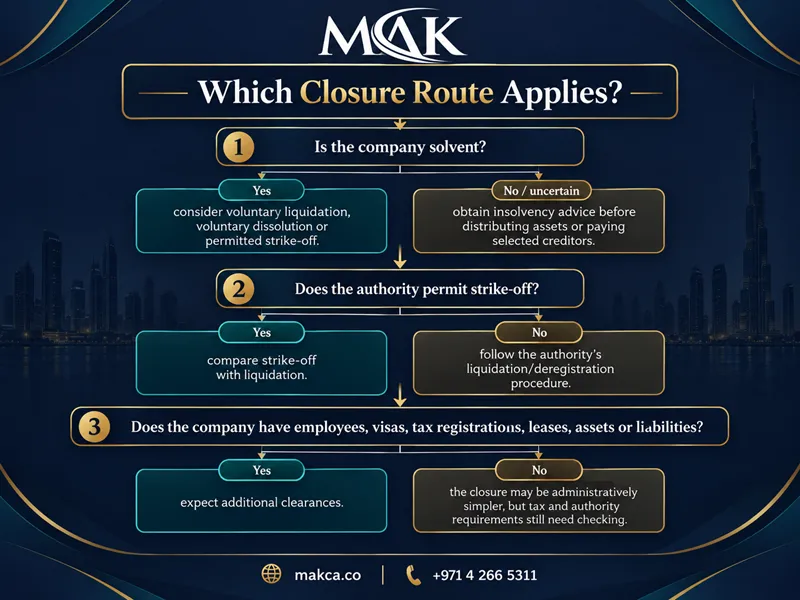
Which Closure Route Applies?
Step 1: Is the company solvent?
Yes: consider voluntary liquidation, voluntary dissolution or permitted strike-off.
No / uncertain: obtain insolvency advice before distributing assets or paying selected creditors.
Step 2: Does the authority permit strike-off?
Yes: compare strike-off with liquidation.
No: follow the authority’s liquidation/deregistration procedure.
Step 3: Does the company have employees, visas, tax registrations, leases, assets or liabilities?
Yes: expect additional clearances.
No: the closure may be administratively simpler, but tax and authority requirements still need checking.
3. Why Do Companies Liquidate in the UAE?
Businesses close for many legitimate commercial reasons. Common reasons include:
- Market exit The owners no longer want to operate in the UAE.
- Business failure Revenue is insufficient to sustain operations.
- Project completion A company was established for a specific project.
- Relocation Owners move operations to another country.
- Partner disputes Shareholders cannot continue under the existing structure.
- Merger or acquisition – The existing entity is absorbed into another structure.
- Regulatory non-compliance The company can no longer maintain its required approvals.
- Dormancy The company has stopped trading but remains registered.
- Business restructuring Owners establish a new entity with a different activity or legal structure.
- Succession or inheritance planning – Ownership changes may make continuation impractical.
What are Uncommon Discussed Reasons for Business Closure?
Some businesses begin a liquidation process because of operational issues rather than poor commercial performance. Examples include:
- partner visa sponsorship problems;
- banking compliance or AML reviews;
- prolonged bank account restrictions;
- inability to maintain required regulatory approvals;
- inheritance or succession complications;
- changes in shareholder structure;
- a group-wide restructuring;
- consolidation of several UAE entities into one company.
A company should identify the reason for closure before selecting the procedure because a straightforward solvent liquidation is very different from an insolvency situation.
What Happens At Time of Company Closure?
| Stage | What normally happens | Typical authority/party |
| 1 | Shareholder/board decision | Shareholders, directors |
| 2 | Resolution preparation and notarisation | Notary / authorised signatory |
| 3 | Liquidator appointment where required | Licensing authority / approved liquidator |
| 4 | Initial liquidation | DET or relevant free-zone authority |
| 5 | Creditor notice | Newspapers / authority requirements |
| 6 | Employee and government clearances | MOHRE, immigration and other authorities |
| 7 | Tax deregistration | FTA / EmaraTax |
| 8 | Bank and liability settlement | Bank, creditors, suppliers |
| 9 | Final liquidation report | Liquidator |
| 10 | Final licence cancellation and deregistration | DET / free-zone authority |
A poorly managed closure can leave unresolved liabilities, tax filings, employee claims, licence penalties or government records. Personal consequences are not automatic, but directors, managers or shareholders can face exposure where separate legal obligations, guarantees, misconduct, insolvency issues or unpaid liabilities create personal liability.
What Are Types of Company Liquidation in the UAE?
Here are detailed types liquidation:
Voluntary Liquidation
Voluntary liquidation is initiated by the owners or shareholders rather than being imposed by a court. It is commonly used when the owners have decided to close a solvent company and want to complete its affairs in an orderly manner. A voluntary route may involve:
- shareholder or board resolution;
- appointment of a liquidator;
- creditor notification;
- settlement of liabilities;
- employee clearance;
- tax deregistration;
- final financial statements;
- final liquidation report;
- licence cancellation;
- deregistration.
Members’ Voluntary Liquidation (MVL)
An MVL is generally associated with a solvent company where the members decide to wind up the business after determining that its liabilities can be paid.
The liquidator administers the remaining affairs and distributes any surplus according to the applicable legal framework.
Creditors’ Voluntary Liquidation (CVL)
A CVL is associated with an insolvent company where creditors have an important role in the winding-up process. If the company cannot pay its debts when due, shareholders should not assume that an ordinary solvent closure is sufficient.
Compulsory Liquidation
Compulsory liquidation generally involves a court-ordered winding-up or another formal process initiated under applicable law. It may arise from circumstances such as:
- insolvency;
- creditor proceedings;
- serious disputes;
- statutory grounds for winding up;
- other circumstances recognised by the applicable legislation.
The UAE’s Federal Decree-Law No. 9 of 2016 concerning Bankruptcy provides a separate insolvency framework, including provisions relevant to companies and creditor protection.
Solvency Self-Check
Before selecting a voluntary route, ask:
Can the company pay all known debts? Are employee wages and gratuity settled? Are taxes and filings up to date? Are there unresolved creditor claims? Are there court cases? Are there personal guarantees? Does the company owe money to its shareholders? Does it hold assets that need to be sold? Is the bank account still active? Are there undisclosed liabilities?
What is UAE Legal Framework for Company Closure?
The legal framework depends on the company’s jurisdiction.
| Law / Regulation | Relevance |
| Federal Decree-Law No. 32 of 2021 on Commercial Companies | Principal federal commercial companies framework |
| Federal Decree-Law No. 33 of 2021 | UAE private-sector employment and termination framework |
| Federal Decree-Law No. 9 of 2016 concerning Bankruptcy | Insolvency and bankruptcy framework |
| ADGM Companies Regulations / Insolvency Regulations | ADGM-specific corporate and insolvency procedures |
| DIFC regulations | DIFC-specific company and insolvency framework |
| Free-zone regulations | Entity-specific dissolution and deregistration requirements |
Federal Decree-Law No. 32 of 2021 is the current principal Commercial Companies Law and replaced the older Federal Law No. 2 of 2015.
Law-to-Jurisdiction Mapping
Mainland Dubai: DET and applicable federal legislation.
Mainland Abu Dhabi: Abu Dhabi Department of Economic Development (ADDED), together with federal requirements.
ADGM: ADGM Registration Authority and its own corporate/insolvency framework.
DIFC: DIFC Registrar and applicable DIFC regulations.
Other free zones: The relevant free-zone authority’s own licence cancellation, liquidation, dissolution or strike-off rules.
ADGM is particularly important to distinguish from ordinary mainland liquidation because its current insolvency framework operates under ADGM-specific regulations. ADGM’s current guidance identifies the Companies Regulations 2020 and Insolvency Regulations 2022 as the relevant framework for voluntary liquidation, while its historical framework included the Insolvency Regulations 2015.
Liquidation/ Company Deregistration Process Mainland Dubai DET
For Dubai mainland companies, the Department of Economy and Tourism (DET) is the key licensing authority for the relevant commercial closure process.
Dubai’s public guidance states that a commercial company requires notarised General Assembly minutes confirming liquidation and appointment of a liquidator, a liquidator acceptance letter and supporting documents. It also specifies a liquidation announcement and a 45-day period for debtors to submit claims.
Step 1: Type the Board/Shareholder Resolution
The resolution should identify the company correctly and give the appointed representative or liquidator appropriate authority. The partners or directors pass a Board Resolution or shareholder resolution confirming the decision to:
- liquidate;
- close;
- deregister the company; and
- appoint an approved auditor/liquidator where required for the closure process.
Step 2: Notary/Court Signing of the Resolution
The authorised signatory or authorised representative under a valid Power of Attorney signs and notarises the resolution through the applicable Dubai notary/court process. The exact signing mechanism can depend on the entity, signatory and documentation.
Step 3: Initial DET Liquidation
For the supplied Dubai mainland workflow:
- Submit the notarised resolution.
- Submit the required initial liquidation application and fee.
- DET processes the initial liquidation request.
- An initial liquidation certificate is issued upon acceptance.
- The liquidation announcement is published.
- The creditor claim period begins.
- Required government clearances are obtained.
Dubai’s current public guidance confirms the use of a liquidation announcement and a 45-day period for creditors/debtors to submit claims.
Newspaper Publication
The public Dubai guidance currently states that commercial companies publish the liquidation announcement in two local newspapers for one day, allowing debtors 45 days to submit claims.
Some professional workflows describe Arabic-and-English publication depending on the case or service provider. Therefore, the publication format should be confirmed against the current DET requirements for the specific application rather than assumed.
Step 4: Government and Utility Clearances
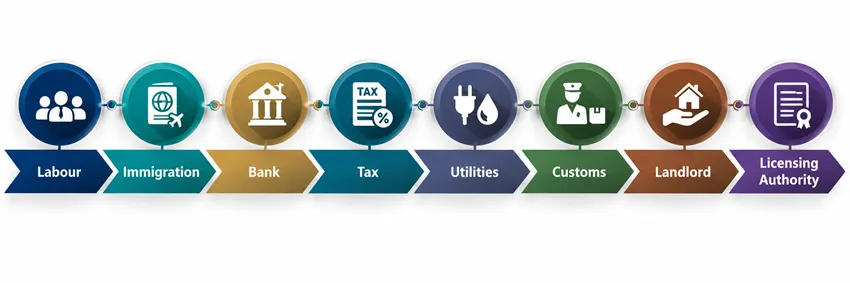
Not every company needs every clearance.Depending on the company, the liquidator may need clearances or confirmations from relevant authorities, such as:
- MOHRE;
- immigration;
- Customs;
- Land Department;
- DEWA;
- Etisalat;
- du;
- DHA where applicable;
- other licensing or sector regulators.
Important Dubai Workflow Note
For the specific DET mainland workflow supplied for this article, all employee visas are to be cancelled before submitting the initial liquidation application.
This is a process-specific instruction and should be checked against the company’s current DET/MOHRE/immigration requirements before filing.
Step 5: Prepare the Liquidation Report?
After the relevant accounts are closed and the final trial balance is available, the liquidator prepares the final liquidation report. Federal Decree-Law No. 32 of 2021 also provides for a final account of liquidation and recording completion with the competent authority. It may cover:
- financial statements;
- assets;
- liabilities;
- creditor claims;
- settlement of debts;
- bank balances;
- distribution of remaining assets;
- outstanding obligations;
- relevant recommendations;
- confirmation of the liquidation position.
Step 6: Final Submission to DET
The liquidator submits the final documentation, which may include:
- final liquidation report;
- bank closure letter;
- evidence of settled liabilities;
- creditor settlement documentation;
- required government clearances;
- final financial information;
- newspaper documentation;
- declarations required by DET.
What is Dubai Mainland Liquidation Fees 2026?
The following figures are the government-fee figures supplied for this guide’s Dubai mainland workflow. Actual charges should be confirmed at the time of application because authority fees, typing/notary charges and third-party costs can change.
| Item | Supplied amount |
| BOR typing and notary signing | AED 1,250 |
| Initial liquidation certificate | AED 520 |
| Newspaper advertisement | AED 1,000 |
| Company labour file cancellation / clearance | AED 84 |
| Company immigration report | AED 192 |
| Immigration / establishment file cancellation / clearance No objection letter for Dubai Customs | AED 250 AED 120 (with custom code AED 3,020 ) |
| Subtotal of supplied listed charges | AED 3,296 |
This AED 3,296 is not a complete universal liquidation price. It excludes items that may arise depending on the company, such as:
- liquidator fees;
- accounting or audit fees;
- tax work;
- VAT deregistration;
- Corporate Tax deregistration;
- legal fees;
- employee settlements;
- gratuity;
- outstanding government penalties;
- bank charges;
- lease cancellation;
- Customs clearance;
- sector-specific approvals.
Cost of Liquidation: What Actually Changes the Price?
The largest cost differences usually come from complexity rather than the basic government filing.
| Complexity | Typical cost drivers |
| Low | No employees, no assets, no creditors, tax filings current |
| Medium | Employees, VAT/CT registrations, lease, bank closure |
| High | Multiple creditors, disputes, assets, tax issues, unpaid liabilities |
| Insolvency | Court, insolvency practitioner, creditor and legal proceedings |
For this reason, a quoted liquidation fee should clearly state whether it includes government fees, liquidator fees, audit, newspaper publication and tax deregistration.
Free Zone Liquidation in the UAE
Free-zone liquidation is not one standard UAE-wide process. The correct procedure depends on the free zone’s regulations and the entity type.
| Jurisdiction | Authority / framework | Closure consideration |
| ADGM | ADGM Registration Authority | Voluntary liquidation, voluntary strike-off and formal insolvency routes are separately regulated |
| DIFC | DIFC Registrar | DIFC-specific dissolution and insolvency requirements |
| DMCC | DMCC | Authority-specific liquidation/de-registration and clearance requirements |
| JAFZA | JAFZA | Entity and licence-specific closure requirements |
| IFZA | IFZA | Deregistration/deactivation options may differ by entity |
| DAFZA | Dubai Airport Freezone | Free-zone authority requirements apply |
| Dubai Silicon Oasis (DSO) | Relevant Dubai authority/free-zone framework | Closure depends on entity and licence |
| RAKEZ / RAK ICC | Relevant RAK authority | Procedures differ by entity type |
| SHAMS | Sharjah Media City | Authority-specific cancellation route |
| SAIF Zone | Sharjah Airport International Free Zone | Authority-specific closure |
| Meydan Free Zone | Meydan | Authority-specific cancellation/deregistration |
ADGM is a particularly clear example of why free-zone processes cannot simply be copied from mainland Dubai. Its current guidance separates voluntary liquidation from voluntary strike-off and formal insolvency proceedings.
Is Free Zone Liquidation Fully Remote?
Not necessarily. Some free zones offer highly digital workflows, but remote completion can still depend on: authorised signatory requirements; notarisation; Power of Attorney; original documents; bank closure; immigration status; audit requirements; physical asset clearance and authority-specific forms.
Employee, Payroll and Visa Obligations
Employees are one of the most important parts of a company closure. UAE labour guidance recognises final closure of an enterprise and bankruptcy/insolvency among circumstances affecting employment termination, subject to the applicable legal requirements. Before closing the entity, the company should reconcile:
- unpaid salary;
- notice pay;
- accrued leave;
- end-of-service gratuity;
- other contractual dues;
- work permit cancellation;
- labour file requirements;
- WPS records;
- employee visa cancellation;
- medical insurance obligations;
- dependent sponsorship where applicable.
Recommended Planning Sequence
A practical sequence is:
- 1. Calculate employee final dues
- 2. Pay salary, leave and gratuity where applicable
- 3. Complete employment/work-permit cancellation through MOHRE
- 4. Complete employee residence visa cancellation through the relevant immigration authority
- 5. Cancel dependant visas where applicable
- 6. Deal with shareholder/owner visas according to the authority’s closure requirements
The precise sequence can vary by company and authority, so the current DET, MOHRE, GDRFA or ICP requirements should prevail.
MOHRE’s service directory confirms that work-permit cancellation is handled through the applicable service channels and that cancellation requirements can differ depending on the employee’s circumstances.
End-of-Service Gratuity Example
For an eligible foreign full-time employee with at least one year of continuous service, the UAE labour framework generally uses:
- 21 days of basic wage per year for the first five years;
- 30 days of basic wage per year after five years;
- proportional calculation for qualifying partial years.
The calculation uses basic wage, not the entire salary package.
Example
Employee basic wage: AED 6,000
Daily basic wage: AED 6,000 ÷ 30 = AED 200
Three years of service:
21 × 3 = 63 days
63 × AED 200 = AED 12,600
So the illustrative gratuity is AED 12,600, subject to the employee’s actual eligibility and circumstances.
Tax Deregistration: VAT and Corporate Tax
Licence cancellation does not automatically remove a business from the Federal Tax Authority’s records. Tax deregistration should be handled separately.
VAT Deregistration
VAT deregistration is completed through the EmaraTax platform. The FTA currently states that VAT deregistration is free and that a completed application is generally processed within 20 business days. The final VAT return and payment are due no later than 28 days from the effective deregistration date.
For a business ceasing taxable activity because its licence is cancelled, the FTA lists documents such as:
- cancelled trade licence;
- liquidation letter;
- board resolution;
- latest financial statements or trial balance;
- relevant labour information.
Corporate Tax Deregistration
Corporate Tax deregistration is a separate FTA process. The FTA currently provides Corporate Tax deregistration through EmaraTax and states that the service is free. The FTA’s published processing time is up to 40 working days after receiving a completed application, with additional time possible if further information is requested.
The company must also deal with its final Corporate Tax compliance obligations.
Do VAT and Corporate Tax Have to Be Cancelled in a Fixed Order?
VAT deregistration and Corporate Tax deregistration are separate tax processes.Therefore, businesses should not assume that VAT must always be cancelled before Corporate Tax, or vice versa. Their timing should be coordinated with:
- actual cessation of business;
- licence cancellation;
- final VAT return;
- final Corporate Tax return;
- accounting close;
- FTA requirements.
Tax Deregistration Warning
Do not wait until years after the company has stopped operating. A dormant company can still have tax filing obligations. The company should determine its final filing and deregistration obligations based on its actual cessation date and tax status.
What are Required Company Liquidation Documents?
A complete document pack can significantly reduce delays.
Corporate Documents
- Trade Licence Proof that the company is legally licensed to operate.
- Certificate of Incorporation/Registration Confirms the company’s legal registration.
- Memorandum of Association Defines the company’s structure, activities, and ownership.
- Articles/Constitutional Documents Sets out the company’s internal governance rules.
- Shareholder Details Identifies the company’s owners and ownership structure.
- Board Resolution Records the directors’ decision to close the company.
- Special Resolution Formal shareholder approval where legally required.
- Shareholder Resolution Confirms the owners’ decision to liquidate or deregister.
- Notarised Liquidation Resolution Legally authenticated approval for the closure.
- Power of Attorney Authorises a representative to act for the company.
- Liquidator Appointment Documents Formally appoints the person handling liquidation.
- Liquidator Acceptance Letter Confirms the liquidator’s acceptance of the appointment.
Financial Documents
- Latest Audited Financial Statements Shows the company’s latest verified financial position.
- Final Trial Balance Summarises account balances before final closure.
- Balance Sheet Shows the company’s assets, liabilities, and equity.
- Profit and Loss Statement Summarises revenue, expenses, and financial results.
- Bank Statements Provides a record of the company’s banking transactions.
- Bank Closure Letter Confirms that the company bank account has been closed.
- List of Assets — Identifies assets owned by the company.
- List of Liabilities — Details outstanding debts and financial obligations.
- Creditor Statement — Lists amounts owed to creditors.
- Debtor Statement — Lists amounts receivable from customers or other parties.
- Settlement Evidence — Proves that outstanding obligations have been settled.
Employee Documents
Employee records typically include the employee list, work permit cancellation documents, visa cancellation records, salary settlement records, gratuity calculations, MOHRE clearance, and WPS reconciliation. These documents help demonstrate that employee-related obligations have been properly settled before the company closure is completed.
Tax Documents
Tax documentation may include the VAT Registration Certificate, VAT returns, VAT deregistration certificate, Corporate Tax registration, Corporate Tax returns, Corporate Tax deregistration confirmation, and relevant EmaraTax correspondence. Together, these records help establish that the company has addressed its applicable FTA filing and deregistration requirements.
Closure Checklist
Before filing
✅ Shareholder/board resolution prepared
✅ Liquidator appointed where required
✅ Resolution notarised
✅Employee dues calculated
✅Employee work permits/visas planned for cancellation
✅Bank liabilities reviewed
✅Creditor list prepared
✅Tax status reviewed
✅Lease reviewed
During liquidation
✅Initial liquidation submitted
✅Initial certificate received
✅Newspaper announcement completed
✅Creditor period monitored
✅Government NOCs obtained
✅Bank account closed
✅Final trial balance prepared
✅Liquidation report prepared
Final closure
✅ Final report submitted
✅Creditor claims settled
✅Tax deregistration completed
✅Final licence cancellation completed
✅ Certificate of Deregistration obtained
✅Corporate records archived
What Is The Liquidation Timeline in the UAE?
There is no single timeline for every UAE company. The timeline depends on the authority, entity type, employees, tax registrations, creditors, bank account, assets and documentation.
| Stage | Simple case | More complex case |
| Resolution and notarisation | 1–5 days | 1–2 weeks |
| Initial authority application | Several days | 1–3 weeks |
| Creditor notice period | 45 days where applicable | 45+ days |
| Employee/visa clearance | 1–3 weeks | Several weeks |
| Bank closure | Several days–weeks | Several weeks |
| Tax deregistration | Authority-dependent | Longer if queries arise |
| Final liquidation report | 1–3 weeks | Several weeks |
| Final deregistration | Several days–weeks | Longer if documents are incomplete |
For Dubai mainland commercial companies, the public government guidance expressly refers to a 45-day creditor claim period after the liquidation announcement.
What delays the Company closing process?
The most common causes of delay include: missing documents; unresolved employee claims; unpaid government penalties; bank closure problems; outstanding rent; creditor objections; tax authority queries; incorrect shareholder documentation; expired identification documents; missing NOCs; disputes and assets that cannot be transferred or sold.
How to Reduce Delays?
Prepare the financial and employee reconciliation before starting the formal application. The liquidator should also create a clearance tracker covering:
Common Mistakes During Company Closure
For early processing and avoiding legal penalties business owners need to consider following points:
Cancelling the shareholder visa too early
The shareholder may still be needed to sign resolutions, authorise documents or complete authority procedures.
Starting visa cancellation before payroll reconciliation
Employee salary, leave and gratuity should be calculated and settled appropriately before final employment cancellation.
Assuming an expired licence means the company is closed
Expiry is not the same as formal deregistration.
Ignoring Corporate Tax
A company that stopped trading may still have outstanding Corporate Tax obligations.
Forgetting VAT deregistration
VAT registration does not necessarily disappear because a trade licence has been cancelled.
Leaving creditors unresolved
A liquidation process does not erase legitimate creditor claims.
Closing the bank account too early
The account may be required to settle final transactions and provide the bank closure letter.
Leaving the UAE before planning the closure
Remote signing may be possible in some circumstances, but it should never be assumed.
Treating every free zone like Dubai mainland
DMCC, JAFZA, IFZA, ADGM, DIFC, DAFZA, DSO, RAKEZ, SHAMS, SAIF and Meydan can have different requirements.
Copying an old liquidation checklist
Authority procedures, online portals, fees and tax requirements can change.
Alternatives to Full Liquidation
Liquidation is not always the only option. Depending on the company’s situation, owners may consider strike-off for eligible inactive entities, suspension or deactivation for temporary inactivity, or sale/transfer when the business still has value. Other options include merger or consolidation for restructuring, activity amendment when the business model changes, or a legal structure change when ownership or corporate structure needs to be revised.
The right option depends on the company’s financial position, liabilities, licensing authority, tax obligations, and future plans.
Free zones such as ADGM may specifically offer voluntary strike-off as an alternative to liquidation. ADGM’s current guidance expressly distinguishes voluntary strike-off from voluntary liquidation and formal insolvency proceedings.
What Happens After Liquidation?
Once the competent authority completes the relevant closure and the company is removed from the applicable register. The business should retain its corporate, financial, tax and employment records for the periods required under the applicable laws and regulations.
Record retention should not be treated as one universal five-year rule for every document. Different records can have different statutory retention requirements. Companies should maintain an organised archive containing:
- liquidation resolutions;
- final financial statements;
- liquidation reports;
- tax returns;
- deregistration certificates;
- employee records;
- creditor settlements;
- bank closure documentation;
- government clearances.
Can a Closed Company Be Reopened?
A former company cannot simply be assumed to be available for immediate reopening after deregistration. Depending on the authority and circumstances, restoration, reinstatement or a new registration may be relevant. If a creditor claim emerges after closure, the legal consequences depend on:
- how the company was closed;
- applicable company law;
- insolvency rules;
- the nature of the claim;
- whether the company can be restored;
- whether directors/shareholders have separate liability.
How MAKCA Helps With Company Liquidation
Closing a company involves much more than submitting a cancellation form. MAKCA can coordinate the financial, accounting, tax and administrative components of the closure process, including:
- Liquidation planning
- Resolution preparation
- Liquidator coordination
- Financial reconciliation
- Final trial balance
- Liquidation report coordination
- Employee settlement calculations
- MOHRE clearance coordination
- Visa and immigration clearance coordination
- FTA VAT deregistration
- Corporate Tax deregistration
- Bank closure coordination
- Government NOC coordination
- Final deregistration documentation
Transparent Cost Planning
Instead of looking only at the licence cancellation fee, a complete quote should identify:Government fees + liquidator fees + accounting/audit + publication + tax + employee settlement + third-party clearances This gives business owners a more realistic view of the total liquidation fees before the process starts.
Conclusion
A proper closure connects several processes: shareholder approval, liquidation or dissolution, creditor notification, employee settlement, government clearances, tax deregistration, bank closure, final financial reporting and formal deregistration.
For Dubai mainland companies, the Department of Economy and Tourism (DET) process is particularly important. The current Dubai government guidance confirms the use of a notarised liquidation resolution, liquidator documentation, newspaper publication and a 45-day creditor claim period for commercial companies.
At the same time, free zones such as ADGM and DIFC operate under their own regulatory frameworks, while tax deregistration remains a separate FTA responsibility.
The safest approach is therefore to treat liquidation as a coordinated legal, financial, tax and administrative project, rather than a simple licence cancellation.
Frequently Asked Questions:
How long does company liquidation take in Dubai?
Dubai’s public guidance provides a 45-day period for creditor claims following the liquidation announcement.
What is the difference between liquidation and company deregistration UAE?
Liquidation is the winding-up process. Deregistration is the removal of the company from the relevant register after the applicable closure requirements have been completed.
Is trade licence cancellation enough to close a UAE company?
No. Trade license cancellation is only one part of the wider closure process. Depending on the company, tax, labour, immigration, banking, lease, Customs and other obligations may also need to be addressed.
Can I close a dormant company?
Yes, but the available route depends on the authority and the company’s circumstances. A dormant company should still have its licence, tax, employee, bank and government records reviewed before closure.
Can I use strike-off instead of liquidation?
Possibly. Some authorities provide strike-off routes for eligible entities. The eligibility requirements vary by jurisdiction.
Do I need a liquidator?
For many commercial company liquidation processes, appointment of a liquidator is part of the formal procedure. However, requirements differ by entity and authority, so the specific licensing authority’s process should be checked.
Do I need VAT deregistration?
If the company is VAT-registered and meets the conditions for deregistration, it must address VAT deregistration separately through EmaraTax. The FTA currently states that VAT deregistration is free and generally processed within 20 business days for a completed application.
Can I leave the UAE while liquidation is in progress?
Possibly, depending on the company’s documents, signatory requirements, immigration status and authority procedures. Do not assume that every liquidation can be completed remotely.
What happens if a creditor appears during liquidation?
The creditor claim should be assessed and dealt with through the applicable liquidation procedure. A disputed or substantial claim may require legal advice.
What happens if the company is insolvent?
Do not automatically use a routine solvent liquidation route. Insolvency may trigger a different legal process under the applicable UAE insolvency framework. Federal Decree-Law No. 9 of 2016 provides the federal bankruptcy framework relevant to qualifying insolvency situations.
Key references include:
- Federal Decree-Law No. 32 of 2021 on Commercial Companies.
- Federal Decree-Law No. 9 of 2016 concerning Bankruptcy.
- Dubai Government — Closing Your Business guidance.
- Federal Tax Authority — VAT Deregistration.
- Federal Tax Authority — Corporate Tax Deregistration.
- ADGM — Voluntary Liquidation Guidance.
- ADGM — Insolvency Regulations and related framework.
- MOHRE — UAE employment and work-permit guidance.