
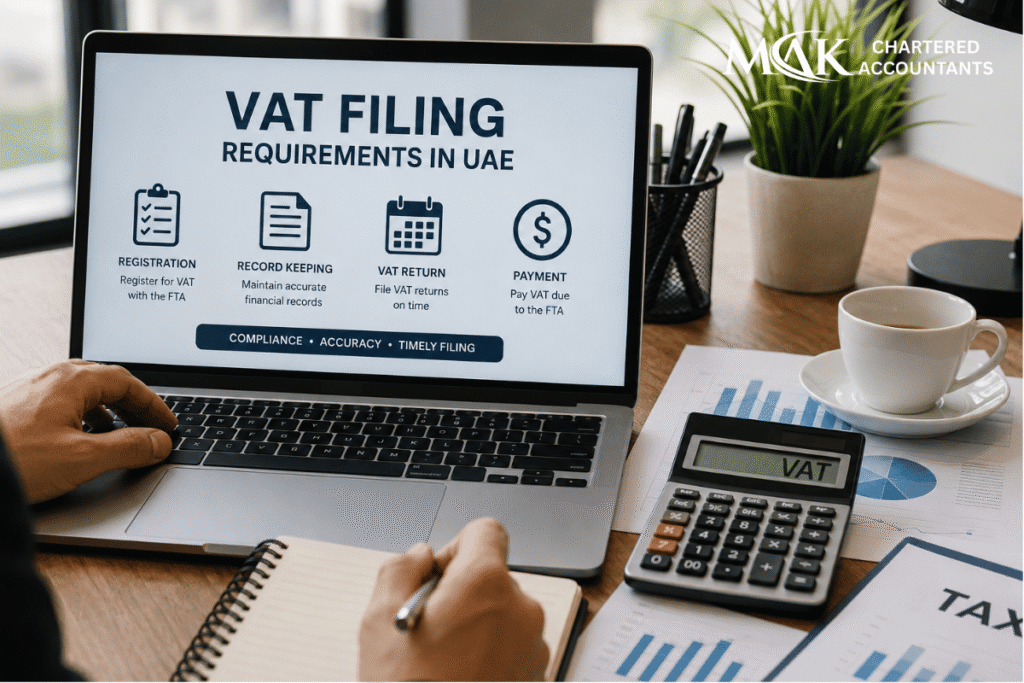
Businesses in the UAE have a responsibility to ensure they are compliant with VAT. VAT registration is just a first step. Additionally, businesses are required to submit timely VAT returns and keep up-to-date financial records and adhere to the VAT filing deadlines announced by the Federal Tax Authority (FTA). Failure to meet this requirement can lead to penalties, interest and needless compliance problems. It does not matter whether you are a Mainland business, a Free Zone business or a small business; knowing the VAT filing requirements will keep your business compliant.
This guide describes who should be filing VAT returns, the essential items of the returns and what records businesses should be keeping during the year.
VAT filing in the UAE involves keeping proper records, calculating the correct VAT, submitting the VAT returns on time and paying the VAT via the Federal Tax Authority (FTA). This guide offers an overview of the VAT filing requirements, documents required, who needs to file VAT and some common mistakes businesses need to avoid.
What are the VAT Filing Requirements in UAE?
VAT filing requirements are the rules businesses have to adhere to upon their registration for VAT in the UAE. These include keeping reliable accounting records, issuing tax invoices, correctly calculating the VAT, filing the VAT returns in time and paying any VAT due to the Federal Tax Authority.
What Is VAT Filing?
VAT filing is the process of submitting a VAT return to the FTA. The return lists the amount of VAT that the business has charged on sales made to customers (Output VAT) and the VAT that it has paid on items that it is allowed to deduct from the taxable turnover (Input VAT). The business pays the difference to the FTA or gets a refund if applicable according to these numbers.
Why VAT Filing Is Important
Correct and timely VAT returns ensure businesses comply with the law and are not penalized. It also maintains financial records in an organised manner, enhances transparency and simplifies future audits or tax reviews. The regular VAT filings provide business owners with a clear overview of their tax situation and cash flow.
Who Must File VAT Returns in the UAE?
VAT registered businesses are required to file VAT returns as per the filing period determined by the Federal Tax Authority. If compulsory or voluntary, once a business is registered it is responsible for fulfilling all of the VAT compliance conditions.
- Mandatory VAT Registration
Businesses must register for VAT if their taxable supplies exceed the mandatory registration threshold set by the FTA. Upon registration, they are required to provide VAT compliant invoices, keep the correct records and submit VAT returns on time and pay VAT on time.
- Voluntary VAT Registration
If a business sells taxable supplies to the mandatory registration threshold, but not to the voluntary threshold, then the business may choose to register for VAT. For startups and development companies, voluntary registration can be helpful as it will enable them to reclaim the full amount of Input VAT which will help to establish their trust and credibility with suppliers and customers.
- Businesses Required to Submit VAT Returns
Many forms of business may be subject to VAT filing requirements such as:
- Mainland companies
- Free Zone companies
- Small and medium-sized enterprises (SMEs)
- Sole establishments
- Startups
- Foreign businesses registered for VAT in the UAE (where applicable)
All registered businesses are required to submit VAT returns even if they have limited or no trading activity in a specific VAT reporting period.
Key VAT Filing Requirements in the UAE
Keeping well-organized financial records the entire year makes it easier to meet VAT filing requirements. Well-kept books and proper records minimise the risk of error and ensure that VAT returns are completed correctly and on time.
- Maintain Accurate VAT Records
A business should keep an accurate record of all sales and purchases for which taxes are due. Accurate accounting records are easier to use and will assist in providing information for VAT returns.
Good records of VAT should contain:
- Sales transactions
- Purchase transactions
- VAT collected
- VAT paid
- Expense records
- Financial reports
Regularly updating these records will minimize errors during the filing.
- Issue Tax Invoices and Keep Supporting Documents
VAT registered businesses should issue VAT-compliant tax invoices for taxable supplies and keep supporting documents of all transactions. These records serve as proof of VAT reporting to the Federal Tax Authority and are crucial for compliance examinations and audits.
Supporting documents are sales invoices, purchase invoices, receipts, contracts and credit/debit notes (if applicable).
- Calculate Output VAT and Input VAT Correctly
To submit a VAT return, it is vital that VAT calculations are correct. Companies need to be precise when calculating:
- Output VAT collected from customers.
- Input VAT paid on eligible business expenses.
Only Input VAT is eligible for claim and businesses should check all calculations thoroughly before submitting, as they may face penalties, adjustments, and errors.
- Submit VAT Returns Before the Deadline
VAT returns must always be filed on or before the due date as given by the Federal Tax Authority. Administrative penalties could be imposed if the return is late, even if there is no VAT to pay. Businesses can keep track of important filing dates and ensure they don’t miss them by using a compliance calendar or by getting accounting software.
- Pay VAT Due on Time
Once the VAT return is submitted, businesses must pay VAT due if applicable within the specified time period. If payment is late, it could result in further penalties and interest. It is also useful to check the VAT calculation before submitting it, to make sure that the correct amount is paid, and to minimise the chance of changing the VAT.
Documents Required for VAT Filing
Having an adequate documentation system in place will make it easier to file VAT, and aid businesses to support the information they report to the Federal Tax Authority (FTA). Although requirements may vary depending on the business, the following records are commonly required.
- Sales Invoices
Sales invoices in line with the VAT regulations, including taxable supplies and VAT amount.
- Purchase Invoices
Invoices issued to businesses for purchasing goods to claim Input VAT.
- Bank Statements
Records of payments and business activity stored at the bank, to support the validation of business transactions and payments.
- Customs Documents (If Applicable)
Import and export documents required for businesses involved in international trade.
- Credit and Debit Notes
Records of any variation to previous invoices which may have an impact on the VAT calculation.
Common VAT Filing Mistakes to Avoid
Simple mistakes can lead to penalties or delays in VAT compliance. Businesses should review their records carefully before filing.
Missing VAT Return Deadlines
Late VAT returns may result in administrative penalties, even if no VAT is payable.
Incorrect VAT Calculations
Errors in calculating Output VAT or Input VAT can lead to incorrect returns and additional reviews.
Claiming Invalid Input VAT
Only VAT on eligible business expenses can be recovered. Unsupported claims may be rejected.
Poor Record Keeping
Missing invoices, receipts, or financial records make VAT filing more difficult and increase compliance risks.
Filing Incorrect Business Information
Incorrect TRN details, business information, or reporting errors may delay VAT processing.
Tips to Ensure Accurate VAT Filing
Businesses can reduce filing errors by following a few simple practices:
- Keep accounting records updated throughout the year.
- Reconcile VAT records regularly before each filing period.
- Use reliable accounting software to improve accuracy.
- Seek professional VAT support for complex tax matters and ongoing FTA compliance.
Conclusion
VAT filing is about more than just completing a tax return. Companies are required to keep the correct records, compute the right amount of VAT, submit on time and have supporting documentation to substantiate. By adhering to these regulations, you can steer clear of penalties and ensure your company remains compliant. For expert help, MAK Chartered Accountant can register you for VAT, help you with VAT return filing, bookkeeping, and whole FTA compliance.
Frequently Asked Questions
What are the VAT filing requirements in the UAE?
Businesses must maintain accurate records, calculate VAT correctly, file VAT returns on time, and pay any VAT due according to FTA requirements.
How often do businesses file VAT returns in the UAE?
Most businesses file VAT returns quarterly, although some may be required to file monthly as determined by the FTA.
What documents are required for VAT filing?
Common documents include sales invoices, purchase invoices, bank statements, customs documents (if applicable), and credit or debit notes.
What happens if a VAT return is filed late?
Late filing may result in administrative penalties, interest charges, and additional compliance reviews by the FTA.
Can I amend a VAT return after submission?
Yes. If an error is identified after submission, businesses can correct it by following the amendment procedures issued by the Federal Tax Authority.